Introduction
AI has progressed from the labs to classes, career expos, and applications people use daily. Hence, there is an amazing opportunity for today’s students to learn about it at a very early age. As a result, learning AI is not just an academic activity for computer science students anymore but something fundamental that will be instrumental for their whole careers regardless of industries they choose. Furthermore, with many businesses trying to use AI-related solutions, today’s students are getting ahead of others simply by learning AI now. In this blog post, we will discuss career possibilities, skills, trends, and ways of education related to AI.
Career Opportunities in AI
The field of artificial intelligence is one of the most diverse choices out there for students who are looking at their career ahead of them. Moreover, since AI spans from healthcare to finance to retail to transport to education, students are not constrained to any particular sector.
Popular Career Paths
Some of the most promising AI career paths include:
- AI Research Scientist – Conducts research to develop next-generation AI algorithms and intelligent systems.
- AI Engineer – Designs, builds, and deploys AI-powered applications for businesses.
- Data Scientist – Analyzes large datasets to extract valuable insights and support business decisions.
- Machine Learning Engineer – Develops, trains, and optimizes machine learning models for real-world applications.
- Generative AI Engineer—Builds AI applications using large language models (LLMs), AI agents, chatbots, and image generation models.
- Prompt Engineer – Creates optimized prompts that improve the accuracy and performance of AI models such as ChatGPT, Gemini, and Claude.
- LLM Engineer – Fine-tunes Large Language Models and develops enterprise AI assistants.
- AI Product Manager – Bridges business goals and AI technologies while managing AI product development.
- AI Ethics & Governance Specialist – Ensures AI systems are fair, transparent, secure, and compliant with regulations.
- Computer Vision Engineer – Develops AI systems for image recognition, facial recognition, medical imaging, and autonomous vehicles.
- NLP Engineer – Builds applications involving language translation, speech recognition, virtual assistants, and chatbots.
- Robotics Engineer – Combines AI with robotics to automate manufacturing, healthcare, agriculture, and logistics.
- AI Security Engineer – Protects AI systems from cyber threats, adversarial attacks, and data privacy risks.
- MLOps Engineer – Deploys, monitors, and manages AI models efficiently in production environments.
Besides that, such professions provide good earning potentials, global possibilities, flexibility to work from home, and stability in employment. With knowledge of Python, Machine Learning, Deep Learning, Cloud Computing, and Generative AI technology, students can equip themselves for well-paid professions.
AI Career Salary & Growth
| AI Career Role | Average Salary (India) | Experience Level | Future Demand |
|---|---|---|---|
| AI Research Scientist | ₹18–45 LPA | Advanced | ⭐⭐⭐⭐⭐ Very High |
| AI Engineer | ₹12–30 LPA | Mid–Senior | ⭐⭐⭐⭐⭐ Very High |
| Data Scientist | ₹10–28 LPA | Mid | ⭐⭐⭐⭐⭐ Excellent |
| Machine Learning Engineer | ₹12–30 LPA | Mid–Senior | ⭐⭐⭐⭐⭐ Excellent |
| Generative AI Engineer | ₹18–45 LPA | Mid–Senior | ⭐⭐⭐⭐⭐ Fastest Growing |
| LLM Engineer | ₹20–50+ LPA | Advanced | ⭐⭐⭐⭐⭐ Extremely High |
| Prompt Engineer | ₹8–22 LPA | Entry–Mid | ⭐⭐⭐⭐ High |
| NLP Engineer | ₹12–32 LPA | Mid | ⭐⭐⭐⭐⭐ High |
| Computer Vision Engineer | ₹12–30 LPA | Mid | ⭐⭐⭐⭐ High |
| AI Product Manager | ₹20–45 LPA | Senior | ⭐⭐⭐⭐⭐ Excellent |
| AI Security Engineer | ₹15–35 LPA | Mid–Senior | ⭐⭐⭐⭐⭐ Very High |
| MLOps Engineer | ₹15–35 LPA | Mid–Senior | ⭐⭐⭐⭐⭐ High |
| Robotics Engineer | ₹8–25 LPA | Mid | ⭐⭐⭐⭐ Growing |
| AI Ethics & Governance Specialist | ₹10–25 LPA | Mid | ⭐⭐⭐⭐ Growing |
Note: Salary ranges are approximate estimates for India (2026–2027). Actual compensation depends on skills, company, location, experience, certifications, and international opportunities.
Skill Development through AI Education
Apart from the career opportunities, learning AI helps one develop a diverse combination of both technical and personal skills that will benefit students wherever they end up heading.
Technical Skills
First of all, the education in AI helps students acquire basic skills that are applicable in practical work rather than theoretical studies only. For example:
- Programming: Hands-on practice with Python and R, the backbone of most machine learning projects.
- Data analysis: Cleaning, visualizing, and interpreting large, messy datasets.
- Algorithms and statistics: Understanding models from decision trees to neural networks.
- Model deployment: Learning how trained models move from notebooks into working applications.
Soft Skills
At the same time, AI education is not purely technical; it also builds interpersonal strengths that carry over into any career. In particular:
Soft Skills
- Problem-solving: Breaking down complex, ambiguous challenges into manageable steps.
- Critical thinking: Evaluating whether a model’s output actually makes sense.
- Collaboration: Working in teams to debug code and refine shared projects.
- Resilience: Iterating patiently through repeated trial and error until a solution works.
Adaptability and Lifelong Learning
Most significantly, AI is a dynamic field; thus, studying it enables students to learn how to be dynamic themselves. Due to the constant development of new technologies each year, students who take courses in AI get used to updating their knowledge instead of sticking to a particular set of skills. As a result, being dynamic becomes a useful quality for one’s future career, as the ability to adapt to change is appreciated more than just possessing a certain degree.
Future Trends in Artificial Intelligence
As we look ahead, there will definitely be more sectors and questions for AI to tackle, and staying informed will make you better equipped for what’s coming next.
Emerging Applications
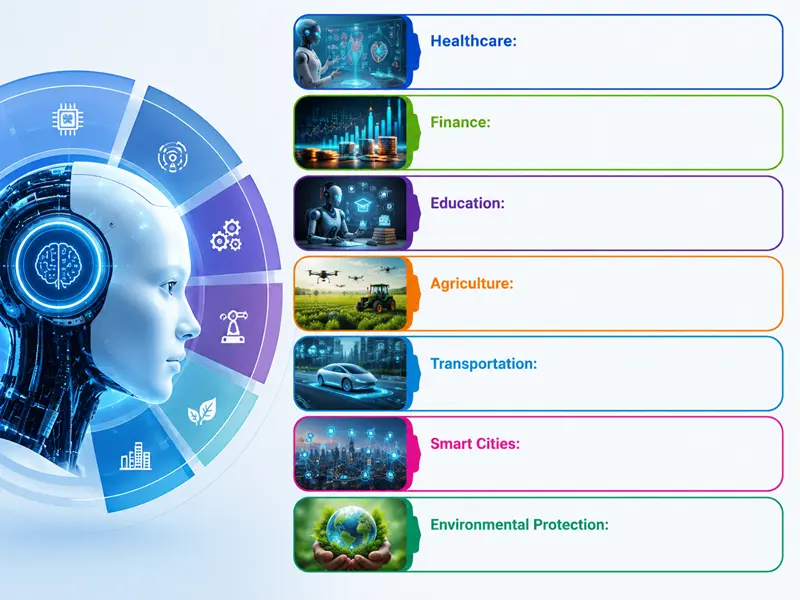
Looking across industries, several sectors stand out as leaders in AI adoption. Namely:
- Healthcare: AI helps doctors to diagnose diseases early, personalize treatment plans for patients, find new drugs, and keep track of patient health remotely. In the future, AI-enabled healthcare systems will increase the accuracy of medicine and decrease healthcare spending.
- Finance: AI is used by companies for customer service, fraud detection, data analytics, stock management, predictive maintenance, and automation. AI increases efficiency and assists businesses to make sound decisions.
- Education: AI is revolutionizing education through personalized learning, intelligent tutoring, automated grading, and virtual classrooms. Students can learn at their own speed with the help of AI-based educational tools.
- Agriculture: Agriculturalists are applying AI in monitoring crops, predicting weather, assessing soils, detecting pests, and even managing irrigation. This technology boosts crop yields while lowering the consumption of water, fertilizers, and pesticides.
- Transportation: The use of autonomous cars, traffic management, routing, and prediction is on the rise. AI can be used to alleviate traffic congestion, increase safety, and save transportation costs.
- Smart Cities: AI helps smart cities manage traffic lights, public safety monitoring, energy optimization, waste management, and emergency response systems.
- Environmental Protection: AI assists scientists in monitoring climate change, forecasting natural disasters, tracking wildlife, reducing pollution, and managing renewable energy sources more efficiently.
Impact of AI on Learning
Remarkably, AI is not only the field students learn, but it is also changing the way they do that.
Personalized Learning
Currently, the use of such AI-based systems enables evaluation of a learner’s strengths and weaknesses and makes lesson complexity level adaptable to the needs of the learner accordingly. Students today do not follow the rigid curriculum anymore but rather study at the speed that suits them best.
Helpful AI Tools
AI tools make our daily tasks easy by increasing efficiency, creativity, and productivity. These tools enable students, professionals, and businesses to do their job effectively and quickly.
- ChatGPT – Generates content, answers questions, and explains concepts. Example: Writing a blog draft in minutes.
- Canva AI – Creates professional designs and presentations. Example: Designing a Pinterest infographic.
- Grammarly – Checks grammar, spelling, and writing style. Example: Editing an email before sending.
- GitHub Copilot – Assists programmers by suggesting code. Example: Completing Python functions automatically.
- Notion AI – Summarizes notes and organizes information. Example: Creating meeting summaries and task lists.
These AI tools save time, increase productivity, and enable users to do their best work without having to exert too much effort. Always check the accuracy of AI-generated content before using it.
Blending AI with Traditional Methods
However, AI should be used to supplement traditional teaching methods rather than completely replace them. Through the use of insights generated by AI combined with discussion in class, practical projects, and mentoring, the learner gets the benefits of efficiency in technological processes as well as mentorship that can only come from a human. The most successful classes, therefore, are those which use both techniques simultaneously.
Conclusion
Learning AI provides students with much more than just a lucrative career path, though earning potential is definitely one of the incentives. In addition, AI education provides students with useful technical and soft skills, makes them ready to handle ethical concerns that arise from new trends, and helps improve the way they learn right now. Thus, those students who dedicate some time to studying AI will not only prepare for their future careers but will also obtain knowledge that will help them learn more effectively right now. As the technology of AI keeps evolving, those who understand it will be able to influence its development.
Frequently Asked Questions
1. Do students need a strong math background to learn AI?
A solid foundation in statistics and linear algebra certainly helps, but many introductory AI courses start with the basics. Therefore, students can build mathematical knowledge gradually as they progress rather than needing expertise from day one.
2. Which programming language should students learn first for AI?
Python is generally recommended because of its simple syntax and extensive libraries for machine learning and data analysis. As a result, most beginner-friendly AI courses use Python as their primary teaching language.
3. Is a computer science degree required to work in AI?
Not necessarily. While many AI professionals hold degrees in computer science or related fields, online certifications, bootcamps, and self-directed projects can also open doors, especially when paired with a strong portfolio.
4. How can students start learning AI today?
Students can begin with free or affordable online courses, participate in coding communities, and experiment with beginner-friendly tools and datasets. Subsequently, they can progress to more advanced projects as their confidence grows.
5. Will AI replace the need for human teachers?
Unlikely in the near future. Instead, AI is best used as a supporting tool that personalizes learning, while teachers continue to provide mentorship, motivation, and the human connection that technology cannot replace.
6. What industries hire AI-skilled graduates besides tech companies?
Healthcare, finance, retail, manufacturing, and education all actively hire AI talent today. Consequently, students are not limited to traditional tech companies and can pursue AI careers across virtually any sector that interests them.