Introduction
The pace of development of technology is extremely fast. And students are right at the heart of all of these changes. These days, artificial intelligence or AI is far from the realms of fiction. Artificial intelligence (AI) is not only seen in films anymore; it has become a reality that millions of students use on a daily basis.
In all academic levels, whether a student is in Class 6 or taking a board examination, artificial intelligence can become their friend.
But how exactly does AI help students in daily life? Let’s explore this step by step.
Makes Learning Personalised
Every student learns differently. Some students understand quickly by reading. Others need visuals or examples. Traditional classrooms often follow a one-size-fits-all method. AI changes this completely. AI-enabled systems analyze your learning style and adapt the material accordingly.
Example:
- If you are having trouble with fractions, it provides you with additional fraction exercises.
- If you are good at grammar, it accelerates your progress.
- It tracks your progress and gives feedback in real time.
Tools such as Khan Academy and learning apps from Google rely on artificial intelligence to make lesson plans personalized to each learner.
Helps with Homework and Doubts
One of the most common daily hurdles faced by students is getting confused with a question that they are unable to solve. This usually happens when students are alone without any guidance from a teacher at night. In this case, AI makes things easier for students.
AI bots and tools like ChatGPT and Google Gemini enable students to:
- Ask any question and get a clear explanation instantly.
- Understand difficult concepts in simple language.
- Get stepwise solutions for mathematical questions.
- Find out whether they got their answers right.
Example:
A student who is learning science in the evening gets stuck when it comes to the process called “photosynthesis.” The student decides not to wait for clarification from the teacher but turns to an AI device and immediately receives a clear explanation with examples.
This means students no longer have to wait until the next day to clear their doubts. Help is available 24 hours a day, 7 days a week.
Improves Writing Skills
Good writing skills are essential for all students. Nevertheless, most students struggle when it comes to effective writing. AI tools are now making writing practice much easier.
Here is how AI helps with writing:
- It checks grammar and spelling mistakes automatically.
- It suggests better words and sentence structures.
- It helps students rewrite unclear sentences.
- It gives feedback on tone, flow, and readability.
Example:
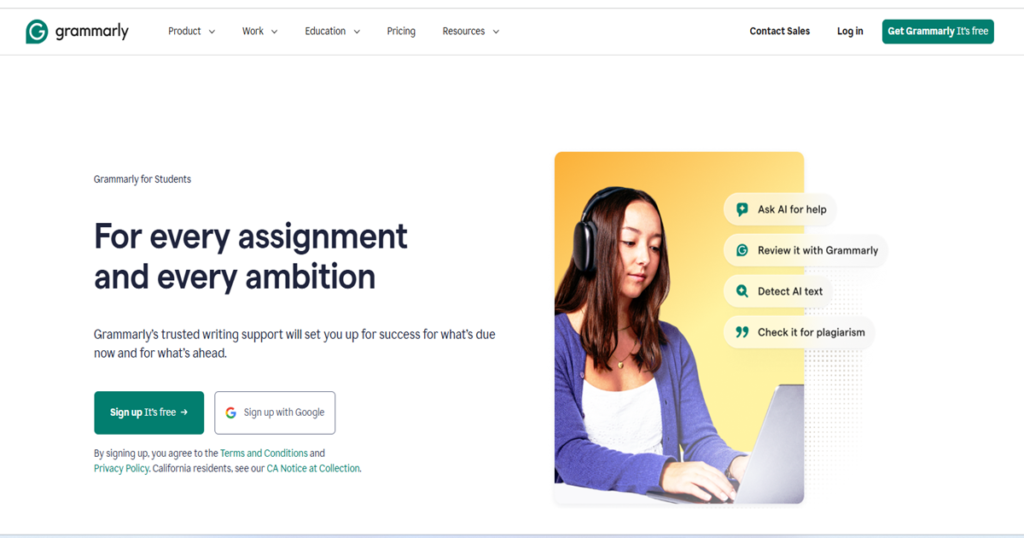
A student writes, “He go to school yesterday,” and an AI tool like Grammarly corrects it to “He went to school yesterday” and also suggests improving the sentence for clarity.
Using applications such as Grammarly will help one learn to write through the use of artificial intelligence. Consequently, the students improve their writing skills unknowingly.
Helps Students Manage Time Better
Time management is difficult for students, as there is a lot to learn and not enough hours in the day. Luckily, AI can assist students in managing their time efficiently.
AI-powered applications that act as planners and smart calendars could:
- Create a schedule for studying, depending on impending exams.
- Remind students of deadlines and assignment submissions.
- Divide complex tasks into simple and easy-to-do parts.
- Identify the ideal time for studying, according to student routines.
Example:
A student enters exam dates in Google Calendar, and it automatically creates a daily study schedule with reminders. When students manage their time well, they feel less stressed and perform better in exams.
Supports Language Learning
Language learning is fascinating and difficult. AI technology has revolutionized language learning in an unprecedented manner.
AI-based language applications such as Duolingo employ advanced algorithms to
- Improve vocabulary via interesting daily lessons.
- Correct pronunciation with voice recognition software.
- Repeat forgotten words repeatedly.
- Modify lesson difficulty according to proficiency levels.
Example:
A student practices English daily on Duolingo, and the app repeats difficult words until the student learns them correctly.
Because of this, students can now learn English, Hindi, French, or any language at their own pace—even without a language teacher.
Helps Students with Research
Research is essential when studying at educational institutions. Previously, students needed to go to libraries and look through piles of books and other documents. However, thanks to artificial intelligence technology, research processes have become much faster and more convenient.
Thanks to AI-based search engines and AI text summarizers, students will be able to
- Finding reliable information in seconds.
- Getting summaries of lengthy texts.
- Comparing several sources instantly.
- Automatically organize research notes.
Example: A student searches a topic on ChatGPT and quickly gets a short summary instead of reading a long article. This saves a huge amount of time and helps students focus more on understanding rather than just collecting data.
Supports Students with Special Needs
AI technology proves very useful in the case of students that encounter learning difficulties. For example, dyslexic students, visually challenged students, or students with hearing problems find it really beneficial using AI technology.
The following points indicate how AI proves beneficial for students having learning difficulties:
- Tools for converting text to speech assist blind students.
- Speech-to-text tools are helpful for students struggling with writing.
- AI captioning assists deaf students in their video lessons.
- Content generators simplify complicated subjects for understanding.
Because of AI, education is becoming more inclusive and accessible for everyone.
Makes Revision Faster and Smarter
Revision is an essential component of exam preparation. But many students have no clue how to revise properly. With the advancement of AI technology, however, students are now revising smarter and faster.
AI-assisted smart revision techniques include the following:
- Create flashcards based on your notes.
- Automatically prepare practice questions based on your syllabus.
- Highlight areas that require your attention.
- Help you memorize through spaced repetition.
Example: A student uploads notes to Quizlet, and it automatically creates flashcards for quick revision. As a result, students spend less time on topics they already know and more time on areas where they actually need help.
Encourages Self-Learning
The biggest gift that AI offers to students is the confidence to learn independently. Traditionally, students relied solely on their teachers. Now, AI enables self-learning.
- Students can research any topic they have an interest in.
- Students can learn beyond what is taught in schools.
- Students can take free online classes with AI assistance.
- Students can work on their projects and receive instant feedback from AI.
This move toward self-learning instills a growth mindset in students at a young age.
Keeping Students Safe Online
With increased usage of the internet by students, safety issues arise. The use of artificial intelligence makes online safety much easier to guarantee for young students.
AI-based content blockers and safety tools:
- Block websites that are not appropriate or dangerous automatically.
- Identify bullying behavior on the internet among friends.
- Monitor screen time and inform parents.
- Keep the student data and information safe.
For this reason, parents and teachers can be assured when students use the internet for educational purposes.
Conclusion
AI is making a real difference in how students are studying and progressing. Be it personalized learning, time management, language education, or even staying safe on the Internet—there’s virtually nothing that AI can’t enhance for students. What’s important about AI, however, is that it doesn’t replace anything but works together with all aspects of studying. It complements everything that teachers and students do. It answers questions, eliminates weaknesses, and opens up possibilities for everyone. This means that the future students who can harness the power of AI will be at an advantage. Therefore, don’t hesitate to become friends with AI when studying, and make it a better experience.
FAQ
Q1. Is AI good or bad for students?
AI is a great tool for students if used properly. It makes learning more efficient, increases understanding, and improves time management skills. Nevertheless, students must remember that AI serves as a helper rather than an escape from thought.
Q2. Which AI tools are best for students?
Khan Academy (personalized learning), Grammarly (helps with writing), Duolingo (learn languages), ChatGPT (solving doubts), and Notion AI (note-taking and planning) are some common AI tools used by students.
Q3. Can AI replace teachers?
No, artificial intelligence cannot replace teachers. This is because teachers can give a human touch to learning that artificial intelligence cannot provide. Artificial intelligence only aids teachers in teaching effectively.
Q4. Is AI safe for school students?
Yes, most of the AI tools created for students are safe. They have very strict privacy policies. However, parents and teachers need to guide young children when using these tools.
Q5. How can students start using AI today?
It’s all about baby steps when it comes to students. They could employ Google Lens to detect objects, Grammarly to edit their work, or ChatGPT to make sense of a challenging topic. Taking things step by step is always the way to go.