Introduction
Blockchain technology is fast becoming one of the most innovative technologies in the education industry, with institutions utilizing it in ways to make their processes more secure, efficient, and transparent. While the use of blockchain may be more popular with the crypto community, this technology can be used in a wide range of ways, such as student records management, digital certificates, verification of credentials, and protecting sensitive information. With an increasing concern over data breaches, certificate fraud, and outmoded record systems, there is a need for better alternatives in this industry.
What Is Blockchain Technology?
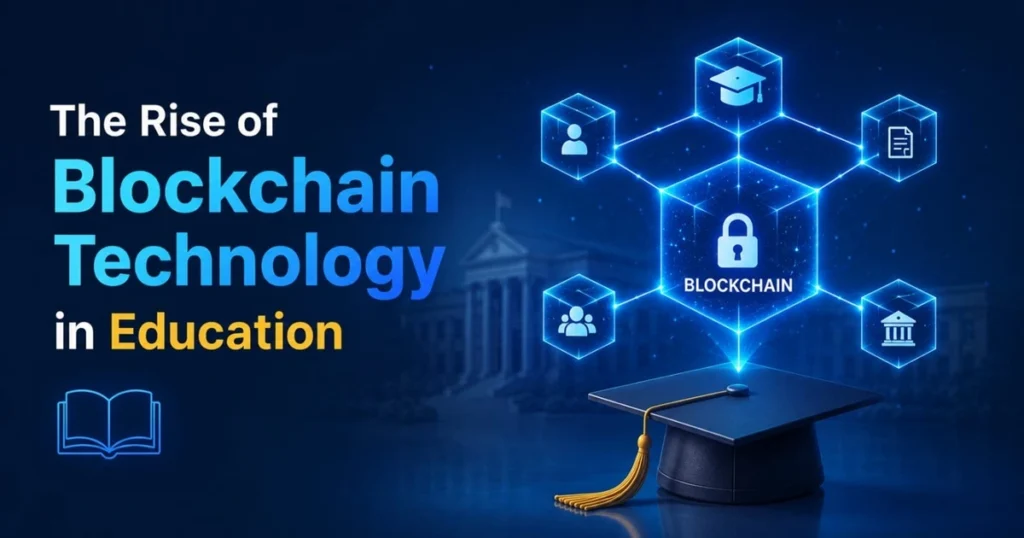
The blockchain is a decentralized digital ledger system that stores information on many computers at once through encryption. In contrast to the traditional data storage approach, blockchain technology does not store data in one place but spreads it all over the network.
Data blocks store each piece of data in blocks. When the block reaches its maximum size, it gets linked to the previous block. In other words, it becomes impossible to make any changes since it is necessary to get confirmation from everyone.
Key Features of Blockchain
- Decentralization
- Transparency
- Security
- Immutability
- Traceability
- Data Integrity
Because of these characteristics, blockchain is particularly suitable for managing sensitive educational information.
Why Education Needs Blockchain Technology
The education sector generates vast amounts of data every year. However, traditional systems often struggle to manage this information efficiently.
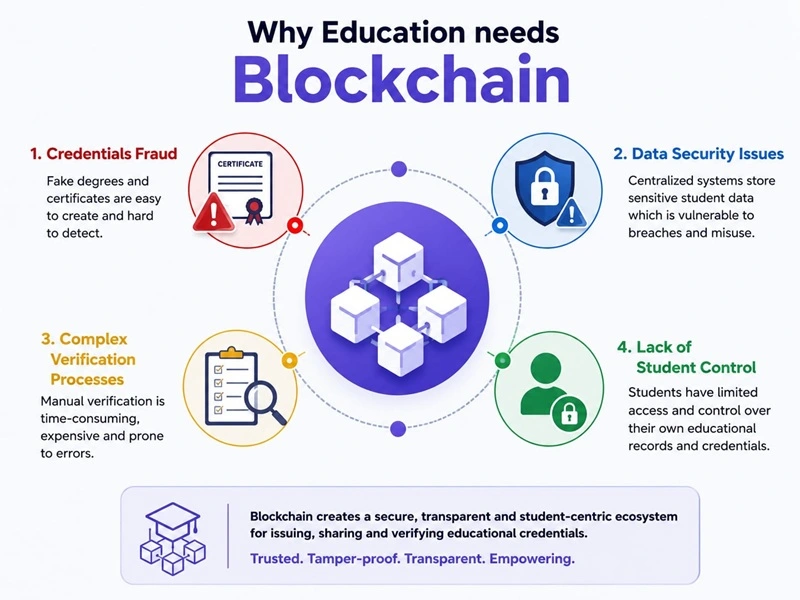
Credential Fraud Is Increasing
However, fake degrees and forged certificates continue to pose huge problems for many people. Employers usually spend a lot of time checking out their employees’ credentials. But blockchain can solve this problem through verifiable digital credentials.
Data Security Challenges
The educational institutions hold personal information, academic information, financial information, and research data. This is why they pose potential targets for the cybercriminals.
Blockchains enhance the security of the institutions by securing records using cryptography.
Inefficient Verification Processes
Students usually face delays while transferring academic record information from one institute to another or while job hunting. Luckily, blockchain technology helps in verifying their accomplishments instantly.
Limited Student Ownership
Conventionally, educational organizations have been responsible for maintaining student records. But with the introduction of blockchain technology, students can own their credentials for lifetime use.
Major Applications of Blockchain in Education
Blockchain technology offers numerous practical applications across educational environments.
Digital Certificates and Diplomas
The most notable application of blockchain technology is that of creating digital certificates.
Paper-based certificates may get lost, damaged, or forged, but digital certificates based on blockchain will remain accessible forever.
Advantages
- Instant verification
- Reduced fraud
- Permanent storage
- Increased employer trust
- Easier international recognition
As a result, graduates can share their credentials confidently with employers worldwide.
Student Record Management
Education organizations have massive data banks where information such as grades, transcripts, attendance, and accomplishments is stored. The use of blockchain technology makes recordkeeping easier through the creation of a secure digital record bank.
Advantages
- Improved accessibility
- Enhanced privacy
- Better data accuracy
- Reduced administrative workload
- Long-term record preservation
Furthermore, students can access their records anytime without relying on multiple institutions.
Online Learning and Micro-Credentials
Online education has led to an increase in the need for reliable credentials verification. Blockchain allows learning platforms to create secure digital badges and certificates for completing a course.
This approach helps learners:
- Showcase skills
- Build professional portfolios
- Verify achievements instantly
- Maintain lifelong learning records
Consequently, employers can trust online credentials more easily.
Academic Research Protection
Research institutions use many efforts to generate original ideas. Thus, it is vital to protect intellectual property.
Blockchain helps researchers by:
- Recording authorship
- Tracking publication history
- Preventing plagiarism
- Establishing ownership rights
Additionally, transparent research records improve trust within the academic community.
Smart Contracts for Education
Smart contracts are computerized contracts that are saved on the blockchain. These contracts work automatically once certain conditions are fulfilled.
Educational institutions can use smart contracts for:
- Scholarship distribution
- Tuition payments
- Student enrollment
- Grant management
- Certification issuance
As a result, administrative processes become faster and more efficient.
Benefits of Blockchain Technology in Education
The adoption of blockchain offers many benefits to both students and organizations.
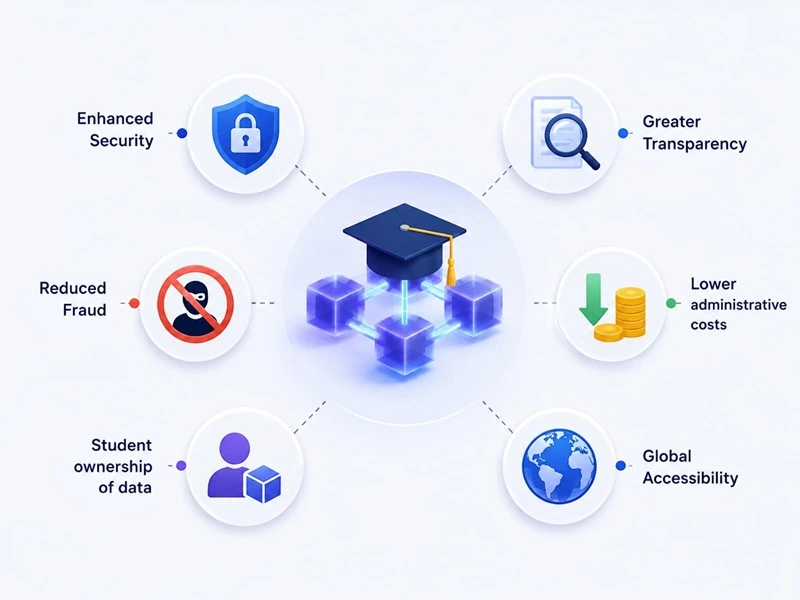
Enhanced Security
This technology utilizes encryption techniques to secure the data. Consequently, unauthorized persons cannot change or access sensitive data.
Greater Transparency
The fact that every transaction is visible and traceable ensures transparency. The independent verification of information by stakeholders is thus possible.
Reduced Administrative Costs
Manual verification procedures take up time and money. But blockchain automates much of this, which helps save costs for the organization.
Faster Credential Verification
Employers can verify qualifications within seconds rather than waiting days or weeks.
Increased Trust and Authenticity
Since blockchain records cannot be easily modified, institutions and employers gain greater confidence in educational credentials.
Student-Centered Data Ownership
Students have full control over their educational transcripts. They can also choose to provide selective credentials to colleges or organizations.
Global Accessibility
Using blockchain technology, educational credentials can be easily accessed around the world. Hence, international students have much to gain from easy credential transfer.
Real-World Examples of Blockchain in Education
Some organizations have already started adopting blockchain technology.
Massachusetts Institute of Technology (MIT)
MIT has provided blockchain-enabled electronic certificates that its graduates can save and transfer.
University of Nicosia
The University of Nicosia was among the earliest adopters of blockchain technology in academic credentials.
Educational Technology Platforms
Most EdTech companies have started offering blockchain-enabled credential verifications for online education platforms.
This shows that the use of blockchain technology has already entered into mainstream applications.
Challenges of Implementing Blockchain in Education
Although there are many benefits associated with blockchain technology, some challenges need to be overcome first.
High Costs Involved in Initial Investment
Using blockchain technology involves considerable investments in various areas.
Technical Challenges
Many organizations do not have the technical knowledge to use blockchain technology.
Issues Related to Scalability
More transactions are expected to occur on the blockchain as more data accumulates.
Regulatory Challenges
Many governments are formulating regulations concerning the application of blockchain technology.
Low Level of Awareness
Not all stakeholders understand the uses of blockchain technology in education.
However, awareness is gradually rising through the use of blockchain.
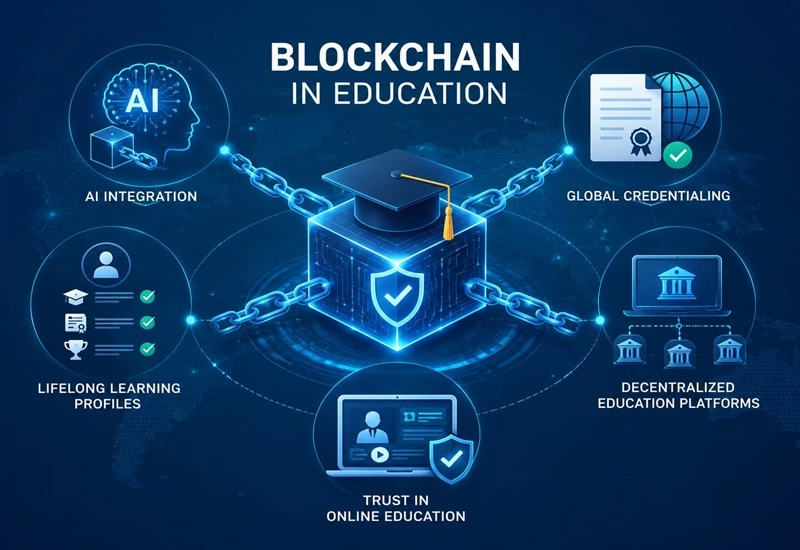
The Future of Blockchain in Education
The application of blockchain technology is set to become ever more prominent within education in years to come.
Integration with Artificial Intelligence
A combination of AI and blockchain may be used to provide an extremely customized learning experience.
Lifelong Learning Profiles
Students might keep one electronic file that stores all educational accomplishments and learning throughout their lives.
Global Credentialing Platforms
Blockchain platforms of the future will allow for instant confirmation of educational credentials worldwide.
Decentralized Education Platforms
Students will be able to enroll in classes offered by several organizations but have just one electronic portfolio.
Trust in Online Education
Blockchain will help to build trust in online education as the practice becomes ever more prevalent.
Therefore, blockchain will be a crucial part of future education systems.
Conclusion
Blockchain technology is revolutionizing education by providing secure, transparent, and efficient ways to manage academic records, certificates, and research data. It helps institutions reduce credential fraud, improve data security, and simplify verification processes. Additionally, blockchain supports innovative applications such as smart contracts and digital credentials, making educational systems more reliable and accessible. Although challenges such as implementation costs and technical complexity remain, the benefits outweigh the drawbacks. As education becomes increasingly digital, blockchain offers a promising solution for creating a trustworthy, student-centered, and future-ready learning environment that benefits students, educators, institutions, and employers alike.
Frequently Asked Questions (FAQs)
- What is blockchain in education?
It refers to the application of digital ledger technology in storing and managing academic records securely in a decentralized manner. - Why is blockchain necessary to prevent certificate forgery?
It ensures the creation of unalterable digital credentials, which can be authenticated in real-time by organizations. - What is the importance of blockchain in education?
Some of its advantages include security, reliability, reduced risks of fraud, efficient credential management, reduced costs, and students’ ownership. - Can blockchain help in making online education better?
Yes. It will assist in authentication of online certificates and tracking learners’ progress. - What are smart contracts in education?
They refer to automated digital agreements used in areas such as scholarships, tuition payments, enrollment processes, and certificate management. - Are there any problems associated with blockchain technology in education?
Some of the challenges include high costs, complicated nature, scalability problems, regulatory uncertainties, and poor awareness levels. - What is the future of blockchain in education?
Some of the developments include integration of artificial intelligence, credential verification across the world, recording lifelong learning history, and decentralized learning platforms.