Introduction
Programming has turned out to be among the most important skills that a student can possess during the current era. This skill enables a person to create websites, develop applications, and even solve many of the challenges that are faced in the world using technology. Having the knowledge on which programming languages to master will give students a great edge and help them remain relevant in the current world. It is important to understand that technology is everywhere; technology influences each and every profession, from medicine to farming.
Understanding Programming Languages
What Is a Programming Language?
A programming language can be described as a collection of instructions and codes used by humans in communicating with the computer. In the same way as you would communicate with someone in the English or Hindi language, you will communicate with the computer through a programming language. In essence, therefore, without programming languages, no software or application would exist.
In addition to that, there are various forms of programming languages. Low-level programming languages such as Assembly are quite close to the hardware, whereas high-level programming languages such as Python and Java use English-like syntax, making them easy to comprehend.
Syntax and Semantics in Programming
Every programming language has two foundational pillars:
- Syntax: The grammar rules of a language. In Python, for example, you write print(“Hello”) to display text. If you break the syntax rules, the computer simply refuses to run the code.
- Semantics: The meaning behind the code. A sentence can be grammatically correct but still make no logical sense. Similarly, code can follow correct syntax but produce wrong results if the logic is flawed.
Understanding both concepts is therefore essential before you write your first real program.
Why Should Students Learn Programming?
Coding skills unlock doors that can never be unlocked by any other kind of skill. The following are the main reasons why students should learn programming from today onwards:
- Coding develops critical and analytical thinking in students.
- Programing prepares students for lucrative jobs in the field of information technology, AI, data science, and website development.
- Furthermore, it enables students to automate routine work and saves time.
- Coding is now an essential part of the curricula of most schools and colleges across the globe.
- Moreover, the option of freelancing and entrepreneurship is greatly enhanced by coding.
Popular Programming Languages for Beginners
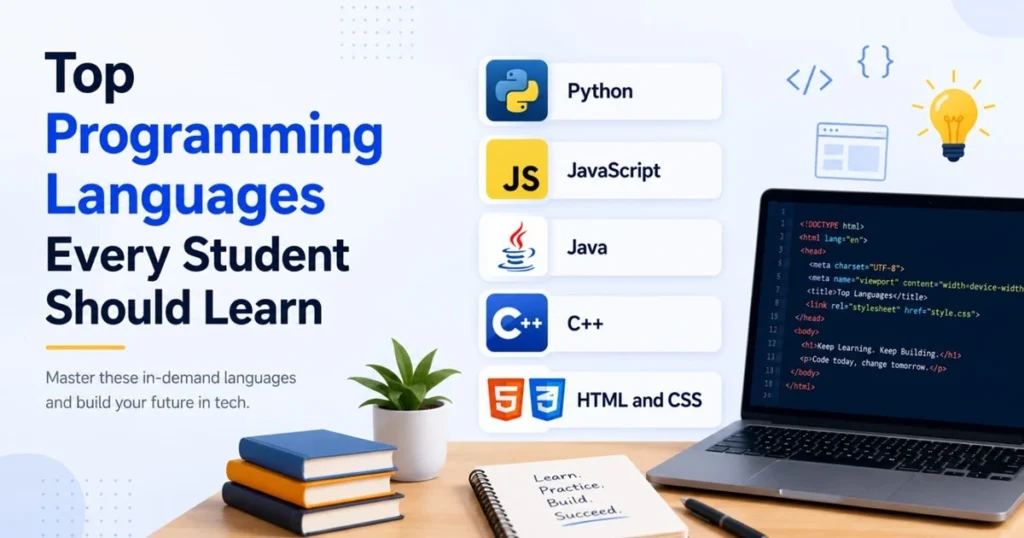
The choice of the right beginner-friendly language is extremely important. The good news is that there are a number of powerful languages that are easy to learn and in high demand. In the following sections, we will discuss the top five languages every student must know about.
1. Python — Best for Beginners and Data Science
Undeniably, Python is the most widely used language by students currently. The simple and easy-to-read syntax of this programming language resembles normal English, making it perfect for beginners. In addition, Python can be used in the field of artificial intelligence, data science, machine learning, and automation.
- Uses: Data Science, Artificial Intelligence/Machine Learning, web development (Django and Flask), and scripting.
- Reasons to learn: Community support, syntax friendly to beginners, and a high job market.
- Additionally, Python is the major language taught in the Class 11 and 12 syllabi of the CBSE.
2. JavaScript — Best for Web Development
JavaScript is executed right within the web browser; therefore, it is the language of the Internet. As a result, any interactive site that you use today will have JavaScript in it. Furthermore, through frameworks like React and Node.js, JavaScript can be used for both the front and back ends.
- Use: Web development, mobile applications, server-side programming.
- Why learn it: Right-away execution within the browser, massive job opportunities, and quick results.
3. Java — Best for App Development and Core Concepts
Java is an extremely powerful and object-oriented language, which has been used to build enterprise-level software and Android apps for decades now. Even though it requires more effort to master than Python, Java is a good language to teach students all of the basics of programming, such as inheritance, polymorphism, and encapsulation.
- Use: Developing Android apps, enterprise software, and banking software.
- Why learn it: Good knowledge of OOP principles and very high job demand among corporations.
4. C++ — Best for Competitive Programming
C++ is the programming language of speed and efficiency. Hence, it finds widespread use in areas like competitive programming, gaming, and systems programming. In addition, C++ enables learners to gain insights into computer memory management and how the computer system works internally. Engineering Olympiads and entrance tests ask candidates to have some knowledge of C++.
- Use: Competitive programming, game engines, operating systems, embedded systems
- Why learn it: Learning about memory and efficiency techniques.
5. HTML and CSS — Best for Web Design
Technically, HTML and CSS are not programming languages but rather markup and styling languages. However, these are the first things that every web developer should learn. In addition to that, the students will immediately see the visual effects, which helps to maintain their motivation. Thus, learning HTML and CSS will provide a great introduction to the field of web development.
- Use: Website construction and design, front-end development, email design.
- Reason to learn: Best way to start learning web development with visual effects.
How to Choose the Right Language to Learn
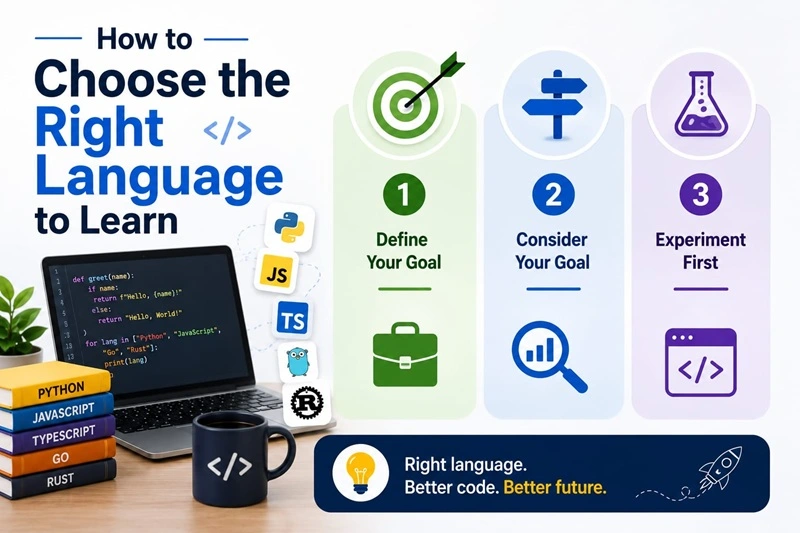
Choosing your first programming language is a decision that requires thought with so many options available. But, by considering a few key factors, you can make an informed decision and save yourself some time.
Factor 1 — Define Your Career Goal
The most important factor is your career goal. For example:
- If you want to do data science or AI, learn Python.
- If web development is your passion, begin with HTML, then CSS, then JavaScript.
- Choose Java or Kotlin for Android development if you are dreaming of developing Android apps.
- If competitive programming interests you, practice with C++.
Factor 2 — Consider Your Current Curriculum
CBSE Class 11 and 12 students already study Python as part of their computer science syllabus. Thus, it helps to have a deeper understanding of Python first. Students in diploma or engineering courses also study C or C++ early in the course.
Factor 3 — Experiment Before Committing
Don’t settle for one language before trying others. Instead, first try short tutorials in two or three languages. Also, make a note of which syntax sounds more natural to you. Most online platforms offer free beginner classes, so it costs nothing but your time to try them out.
Tips for Faster Learning
- Pick a specific daily practice time. Even 30 minutes a day is better than weekend marathons.
- Begin mini projects on day one. Projects help concepts stick a lot better than passively reading.
- And to keep yourself motivated and get your questions answered quickly, join coding communities as well.
- Space out your review of concepts in order to avoid cramming.
Resources and Tools for Learning Programming
The right resources speed your learning up dramatically. Luckily for today’s students, world-class programming courses are available for free. Here are the best platforms and tools to get started right away.
Best Online Learning Platforms
- freeCodeCamp: A completely free platform covering HTML, CSS, JavaScript, Python, and more. Furthermore, it awards certificates upon completion, which you can add to your resume.
- Codecademy: Offers interactive, browser-based coding lessons. Additionally, it provides structured learning paths for beginners.
- Khan Academy: Excellent for absolute beginners, especially for JavaScript and web fundamentals. Moreover, the teaching style is simple and highly visual.
- Coursera and edX: Offer university-level courses from institutions like MIT and IIT. Many courses are free to audit, though paid certificates are also available.
- W3Schools: A quick reference and tutorial site for HTML, CSS, JavaScript, Python, SQL, and more. It is particularly useful for students who prefer reading over video lessons.
- computersiksha.com: Our very own platform offering curriculum-aligned content for Class 6 to 12 students, including Python, HTML, AI, networking, and MCQ-based practice sets.
Communities and Forums for Support
Learning alone is challenging. Joining a community keeps you motivated and helps you solve problems more quickly.
- Stack Overflow: The largest Q&A community for programmers.
- GitHub: Use GitHub to store your projects and work with others around the world.
- Reddit communities like r/learnprogramming offer support and practical tips.
- Discord servers for Python, JavaScript, and other languages provide help in real time.
The Importance of Hands-On Practice and Projects
It is easy to get complacent with just reading about how things work and not putting in the work. So obviously, no hands-on is a big no-no. Further, the only way one can learn many valuable things that go beyond and below the tutorial scope is to build actual, small (or big) projects.
Check below to learn some beginner projects for each language:
- Python: Build a simple calculator, a quiz game, or a weather app using an API.
- JavaScript: Create a to-do list app, a countdown timer, or a quiz website.
- HTML and CSS: Design your personal portfolio page or a school project website.
- Java or C++: Solve beginner problems on HackerRank or CodeChef daily.
Conclusion
Programming is one of the most valuable skills students can learn today. Starting early gives you a strong advantage in academics and future careers. Python is the best language for beginners, while JavaScript, Java, C++, and HTML help you explore web development, software, and more. You don’t need to master every language at once—choose one, practice daily, build small projects, and keep learning consistently. Visit computersiksha.com for easy tutorials, MCQ practice, and curriculum-based study notes specially designed for Class 6–12 students. Start coding today—one line can change your future!
Frequently Asked Questions (FAQs)
Q1. Which programming language is best for Class 11 and 12 CBSE students?
Python is the officially recommended language for CBSE Class 11 and 12 computer science students. Furthermore, it is also the most beginner-friendly language available today, making it a perfect starting point.
Q2. Can I learn programming without any prior knowledge?
Absolutely yes. Languages like Python and HTML require no prior coding knowledge. Moreover, hundreds of free resources are available specifically designed for complete beginners. All you need is consistency and curiosity.
Q3. How long does it take to learn a programming language?
It depends on the language and your practice consistency. However, most students become comfortable with Python basics within four to six weeks of daily practice. Additionally, building projects alongside learning speeds up the process significantly.
Q4. Is it better to learn Python or Java first?
Python is generally the better first choice because of its simple syntax and immediate results. However, if your school curriculum requires Java, or if you specifically want to build Android apps, starting with Java is also a perfectly valid decision.
Q5. Are HTML and CSS programming languages?
HTML and CSS are technically not programming languages. Instead, HTML is a markup language that structures web content, while CSS is a styling language that controls appearance. Nevertheless, every web developer must learn both before moving on to JavaScript.
Q6. Where can I practice programming for free?
You can practice on freeCodeCamp, Codecademy, HackerRank, CodeChef, and Khan Academy, all of which are completely free. Additionally, computersiksha.com offers MCQ-based practice and study notes specifically designed for Indian school students.